Replacing Hydraulic Cylinders with Electromechanical Actuators: A Complete Engineering Guide
Discover why industrial OEMs are shifting from fluid power to electromechanical actuators. We analyze the technical benefits, ROI, and how to successfully size a roller screw actuator for hydraulic replacement.
For decades, hydraulic cylinders have been the default choice for high-force linear motion in heavy industry, metal forming, and mobile equipment. Today, many engineering teams are evaluating Electromechanical Actuators (EMAs) powered by planetary roller screws where cleaner control, data capture, and lower maintenance matter.
If you are evaluating the transition from hydraulics to EMAs, here are the primary technical drivers, ROI factors, and critical engineering steps for a credible architecture shift.
1. The True Cost of Hydraulic Systems
While hydraulic systems are excellent at delivering high force at a relatively low initial component cost, they can carry a significant hidden Total Cost of Ownership (TCO):
- Energy Inefficiency: Hydraulic power units (HPUs) often run continuously to maintain system pressure, wasting energy during idle or holding periods. Overall system efficiency (from electrical grid to mechanical work) is commonly far below a direct electromechanical axis.
- Maintenance and Leaks: Fluid leaks can occur over time, leading to environmental hazards, contaminated products, and high maintenance overhead. The cost of hydraulic fluid disposal and leak cleanup is often unaccounted for in initial budgets.
- Control Limitations: Precise position, velocity, and force control are notoriously difficult to achieve and maintain with hydraulic proportional valves, especially as fluid temperature changes throughout the day.
- Massive Footprint: The total system footprint includes not just the cylinder, but the hoses, high-pressure pumps, reservoirs, filters, and accumulators.
2. The Electromechanical Advantage
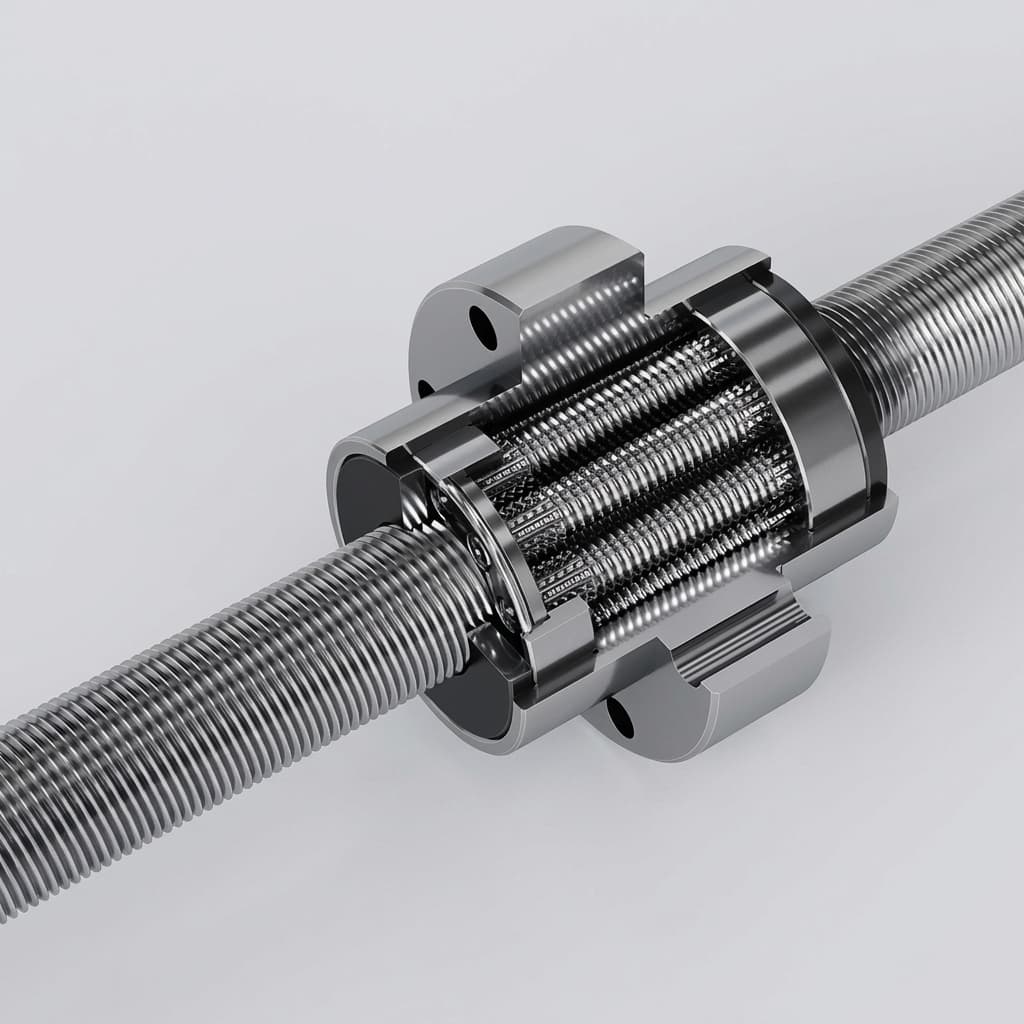
Electromechanical actuators utilizing planetary roller screw technology convert electrical energy directly into linear motion through a servo motor and precision screw.
Superior Efficiency and ROI
EMAs consume most of their power while moving or actively holding a load. In idle states, or when a brake or mechanical load path holds the position, energy use can drop sharply compared with a continuously running hydraulic power unit.
Illustrative System Efficiency Comparison
| Metric | Hydraulic Cylinder System | Electromechanical Actuator |
|---|---|---|
| System Efficiency | Often lower at system level and strongly duty-dependent | Often higher for a well-sized axis with suitable holding strategy |
| Power Consumption | Continuous (HPU running) | On-Demand (Moves only) |
| Environmental Impact | Risk of leaks, fluid disposal | Clean, dry operation |
| Maintenance | High (filters, seals, fluid) | Low (periodic grease) |
| Data Acquisition | Requires external sensors | Built-in via servo drive |
ROI Review: Payback depends on cycle rate, HPU idle time, maintenance history, downtime cost, and energy price. Use real machine data rather than assuming a fixed payback period.
Programmable Precision and Control
Driven by closed-loop servo motors, EMAs support programmable motion profiles. Engineers can more precisely and repeatably control:
- Position: Fine position targets when encoder resolution, structure, calibration, and backlash control support them.
- Velocity: Seamless, multi-step acceleration and deceleration profiles.
- Force: Real-time force control through motor current monitoring or external load cells.
3. How to Size an EMA for Hydraulic Replacement (Without Oversizing)
One of the most common and costly mistakes when transitioning to EMAs is sizing the actuator based purely on the hydraulic system's maximum pressure rating.
Avoid The 3000 PSI Trap
If a legacy machine uses a 4-inch bore cylinder rated for 3,000 PSI, the theoretical max force is ~37,000 lbs. Engineers often request an EMA with a 37,000 lb rating. However, the actual application may only require 10,000 lbs of force. Because oversizing a hydraulic cylinder is cheap, they are frequently massively oversized. Oversizing an EMA, however, drastically increases the cost, size, and motor requirements.
Best Practices for Sizing:
- Determine the Real Load: Do not guess. Calculate or physically measure the actual working force required by the application using load cells on the existing equipment.
- Analyze the Motion Profile: Map out the exact duty cycle, including move times, dwell times, and payloads during each segment. EMAs are sensitive to RMS (Root Mean Square) continuous torque and thermal limits.
- Select Planetary Roller Screws for Heavy Duty: For low-force, light-duty applications, a ball screw may suffice. For demanding hydraulic replacement work involving high forces, shock loads, or frequent cycles, a planetary roller screw is typically preferred to achieve the required force density and reduce brinelling risk.
Hydraulic-to-Electric Data Conversion Table
| Hydraulic Data | Electric Actuator Review |
|---|---|
| Bore, rod diameter, and operating pressure | Rated force, peak force, and safety factor. |
| Pump flow and valve behavior | Required linear speed, acceleration, and control response. |
| Pin-to-pin length and mounting style | Retrofit envelope, motor position, rod end, and side-load control. |
| Duty cycle and dwell time | RMS load, motor heat, brake holding, and lubricant temperature. |
| Pressure spikes and impact events | Shock factor, screw load rating, bearing support, and overload behavior. |
| Counterbalance or check valve function | Brake, rod lock, counterbalance, or mechanical holding strategy. |
| Oil, dust, washdown, or outdoor exposure | IP rating, sealing, corrosion protection, and maintenance access. |
Use the hydraulic replacement application page when the primary question is retrofit feasibility, and the high-force electromechanical actuator page when the main question is actuator architecture and factory validation.
Thermal Management and Duty Cycle Limitations
One practical advantage of many hydraulic systems is their ability to hold high loads through fluid pressure and external hydraulic components, with heat managed by the broader power unit and fluid circuit.
Conversely, holding a load with an EMA requires continuous electrical current to the servo motor, which generates heat ($I^2R$ losses). If an EMA is subjected to a 100% duty cycle with high RMS torque, the motor and the screw can overheat, degrading the lubricant and burning out the stator.
- The Solution: To replace hydraulics in high-duty holding applications, EMAs often need power-off holding brakes, rod locks, counterbalances, or mechanical toggle linkages to hold force without continuous motor current.
Failsafe Mechanisms and Safety Constraints
In critical infrastructure (e.g., dam gates or heavy lifting), hydraulic systems may use counterbalance valves and pilot-operated check valves to hold the cylinder position if a hose ruptures or power is lost.
To achieve this level of safety in an electromechanical system, engineers must specify redundant braking:
- A primary spring-applied, electrically released (SAER) brake on the servo motor.
- In extreme cases, a secondary safety catch or rod lock mechanism directly on the actuator thrust tube.
Industrial Network Integration (Fieldbus / Ethernet)
Hydraulic systems require complex analog I/O wiring to interface valves and pressure transducers with the main PLC.
Electromechanical actuators can simplify this interface. Modern servo drives communicate directly over industrial Ethernet protocols (e.g., EtherCAT, PROFINET, EtherNet/IP, Powerlink). A single network connection can transmit position commands from the PLC while feeding back position, velocity, and motor torque data. The final wiring and cabinet impact still depends on safety hardware, brake wiring, sensors, and machine architecture.
4. Summary
The shift from fluid power to electromechanical actuation is strong in applications where controllability, cleanliness, maintenance reduction, and process data matter. It is still an engineering decision: shock load, speed, safety behavior, and envelope can make some hydraulic axes difficult to replace directly.
We help OEMs review load-life sizing, thermal behavior, motor and brake selection, validation criteria, and custom packaging. Start with the engineering sizing checklist, then contact us with cylinder data, photos, drawings, and the current duty cycle.
Author

Categories
More Posts
Specifying Roller Screw Actuators for Continuous Duty (S1) Applications: Thermal Management and Sizing Guide
Sizing roller screw actuators for S1 continuous duty: RMS force, thermal derating, cooling options, lubrication risks, and RFQ checks for engineers.
How to Specify Condition Monitoring and Predictive Maintenance (PdM) for Roller Screw Actuators
A comprehensive guide for procurement and engineering teams on specifying temperature, vibration, and force sensors for predictive maintenance in roller screw actuators.
Roller Screw vs. Ball Screw: Which Linear Actuator is Right for Your Application?
A comprehensive engineering comparison of roller screws and ball screws, focusing on load capacity, lifespan, speed, and typical use cases in industrial automation.